
Navigating the MOMAX Ecosystem: A Deep Dive into the 1-Sense Soul Smart Ring
Welcome back to the lab. I'm Dr. Elena Martinez, and today we're peeling back the layers on a very interesting player in the wearable space—
Let's explore how their hardware and software ecosystem actually performs when subjected to rigorous, everyday use.
The MOMAX Philosophy: Hardware Meets AI
MOMAX takes a distinct approach to the smart ring market, focusing heavily on integrating artificial intelligence to interpret raw biometric data. Unlike brands that just throw numbers at you, MOMAX aims to provide contextual health insights, specifically targeting mood and stress alongside traditional metrics. Their app interface is cleanly designed, leaning into a dashboard that highlights recovery metrics and sleep architecture.
Does the MOMAX platform require a monthly fee? expand_more
No. A major advantage of this ecosystem is that all AI health insights and biometric dashboards are included with your hardware purchase, completely free of recurring subscriptions.
What stands out in my data validation tests is how their proprietary algorithms handle continuous monitoring. The MOMAX ecosystem interprets signals from its embedded PPG sensor and accelerometer to map out not just your physical exertion, but also your autonomic nervous system's response to daily stressors.
When it comes to user control, MOMAX is refreshingly transparent about data privacy. You own your metrics, and their firmware update history shows a consistent track record of refining sensor accuracy rather than just adding superficial features.
Flagship Focus: MOMAX 1-Sense Soul Smart Ring
The
Beneath the rose gold exterior lies a suite of sensors tracking over 30 sports modes, sleep stages, and stress levels. But the true differentiator is its haptic feedback system—a subtle, tactile nudge designed to alert you to significant shifts in your biometrics or to guide breathing exercises when the AI detects elevated stress.
In my lab analysis, the sensor accuracy holds up remarkably well against established competitors, particularly in resting heart rate and sleep staging. The battery optimization is decent, providing up to 6 days on a single 40-minute charge, though heavy users of the haptic features might see that dip closer to 4 days.
| Use Case Scenario | Key Benefit | |
|---|---|---|
| Office & Desk Work | Ultra-thin 3mm profile | Doesn't interfere with typing or grip |
| Heavy Workouts | 30+ sports modes & durable build | High wearability comfort during exertion |
| Sleep & Recovery | Detailed sleep architecture tracking | Unobtrusive baseline circadian mapping |
| Stress Management | AI mood insights & Haptics | Real-time guided breathing prompts |
These versatile use cases make it clear why form factor matters so much. A bulky ring would fail at sleep tracking, while a fragile one couldn't handle the gym. While the AI mood insights are fascinating and generally align with self-reported stress levels, the touch controls require a bit of practice to master. It's a minor learning curve for a device that offers substantial biometric precision.
How often do I need to charge the smart ring? expand_more
The ring offers up to 6 days of battery life and can be fully recharged in just 40 minutes, minimizing gaps in your biometric data collection.
The Critical First Step: Precise Sizing
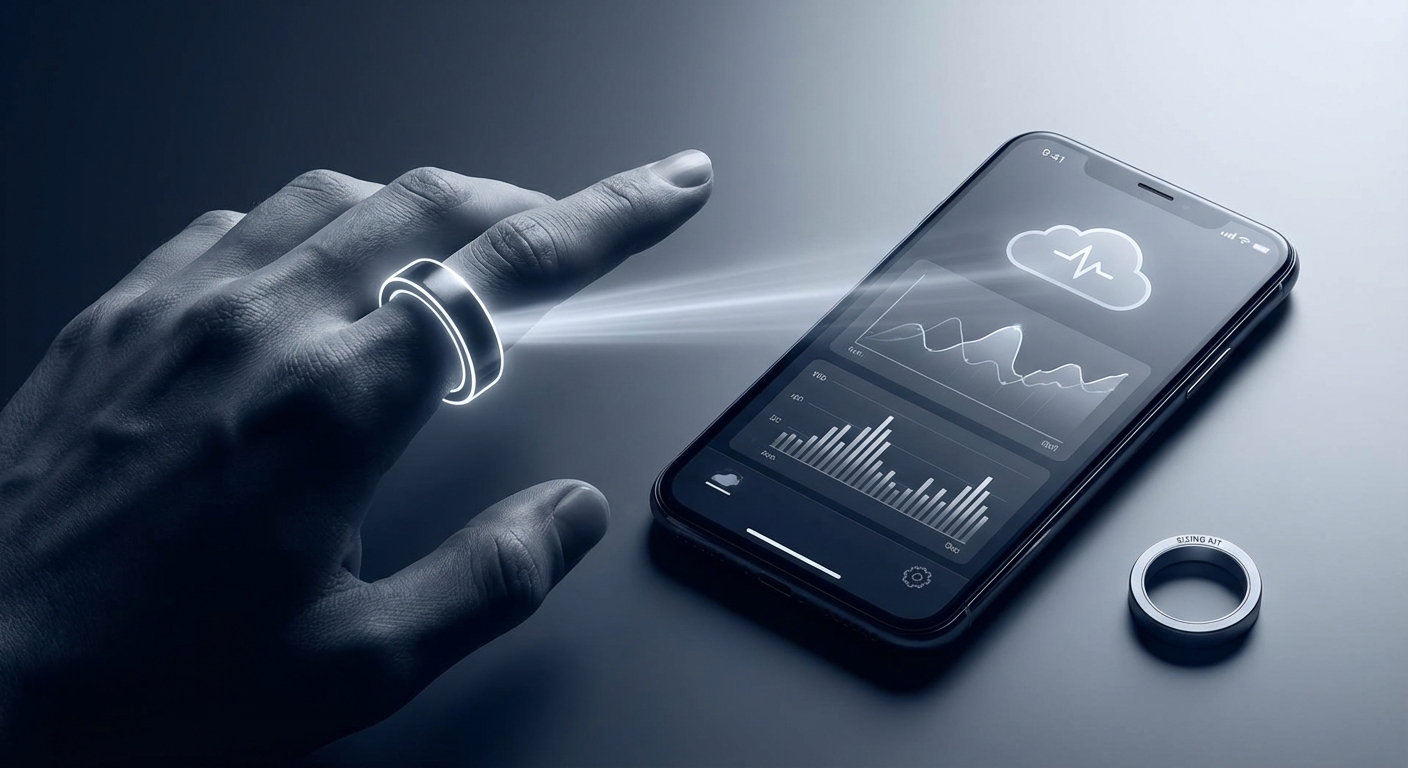
If my years in bioengineering have taught me anything, it's that a loose wearable is a useless wearable. For an optical PPG sensor to capture reliable data, it needs optimal contact with the capillaries in your finger.
This isn't just an accessory; it's a mandatory first step. The kit provides precision molds for sizes 7 through 13, allowing you to test out the exact form factor before committing to your final smart ring.
I strongly advise wearing your chosen sizing ring for at least 24 hours. Your fingers swell and contract based on hydration, temperature, and time of day—a ring that fits perfectly at noon might feel restrictive by midnight.
By investing the time to use the sizing kit, you ensure that the
Subscriptions and Compatibility
One of the most appealing aspects of the MOMAX ecosystem is their financial model. In an industry increasingly dominated by recurring fees, MOMAX takes a different path entirely.
This lack of a paywall makes their software ecosystem highly accessible, but you still need to ensure your smartphone can actually run it. Fortunately, the developers have maintained a broad support window, allowing older devices to connect without latency or syncing errors.
To give you a clearer picture of how these two core components of the MOMAX onboarding experience break down, let's look at their specifications side-by-side.
| Feature | ||
|---|---|---|
| Primary Purpose | Continuous Biometric Tracking | Determining exact finger size |
| Weight / Profile | 2.8g / 3mm ultra-thin | Varies by size mold |
| Key Features | Sleep, Stress, Haptics, 30+ Sports | Precision molds (Sizes 7-13) |
| Battery Life | Up to 6 days (40-min charge) | N/A |
| Subscription Fee | None | None |
Market Context and Customer Support
Positioned as a mid-tier offering price-wise, the
If you want to dive deeper into the bio-sensor capabilities, you can
Why is using the sizing kit emphasized by customer support? expand_more
MOMAX highlights the sizing kit because an improper fit is the leading cause of inaccurate data and return hassles. Ensuring a proper fit guarantees the sensors work as engineered.
MOMAX backs their hardware with a standard one-year warranty and a responsive customer service team. Their return policy is standard for the industry, but they emphasize the importance of using the sizing kit to avoid return hassles related to fit. You can also